











AI vs Human Intelligence: Differences, Similarities, and the Future.
Explore the core differences between Artificial Intelligence (AI) and Human Intelligence (HI). Learn about their unique strengths in learning, creativity, problem-solving, and the exciting future of hybrid intelligence.

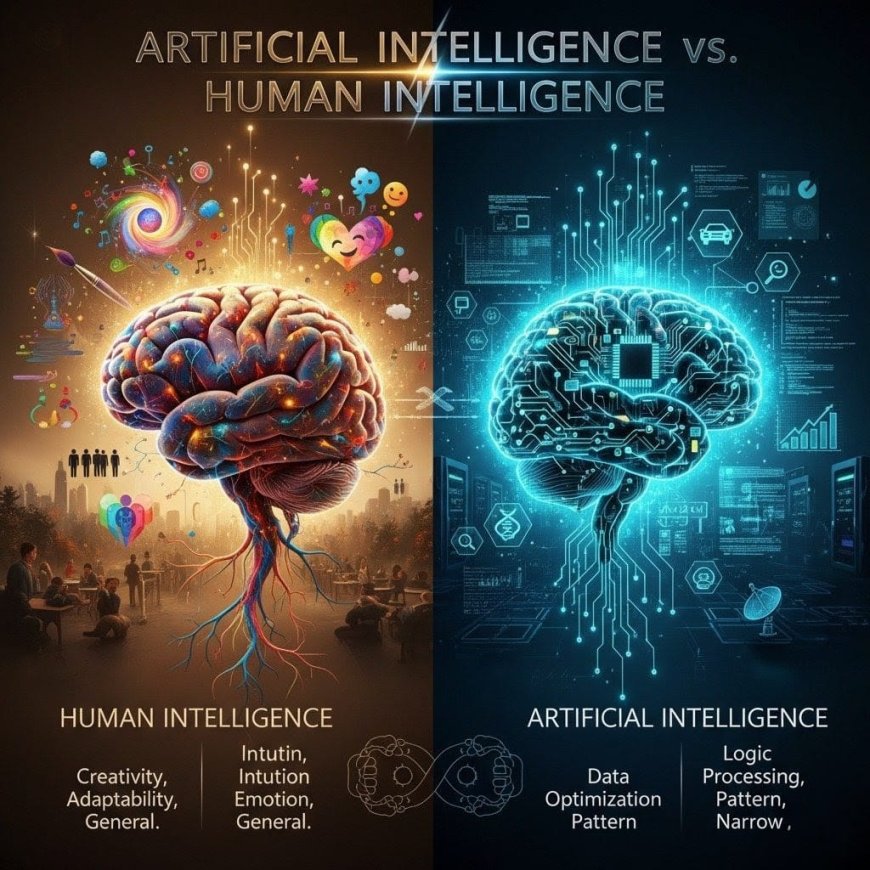
Artificial Intelligence vs Human Intelligence: A Deep Dive
The realm of intelligence, once considered an exclusive dominion of humanity, is now increasingly shared with artificial counterparts. As Artificial Intelligence (AI) rapidly advances, the debate intensifies: how does it compare to the intricate, nuanced, and often unpredictable nature of human intelligence? This article will explore the key distinctions, similarities, and the future implications of this fascinating comparison.
Defining the Intelligences
Before drawing parallels, it's crucial to understand what we mean by both terms:
Human Intelligence (HI): This encompasses a vast array of cognitive abilities, including reasoning, problem-solving, learning from experience, adapting to new situations, understanding complex ideas, planning, and emotional intelligence. It is deeply intertwined with consciousness, self-awareness, creativity, intuition, and the ability to form complex social relationships. HI is biological, evolving over millions of years, and is intrinsically linked to our physical bodies and sensory experiences.
Artificial Intelligence (AI): In its broadest sense, AI refers to the simulation of human intelligence processes by machines, especially computer systems. These processes include learning (the acquisition of information and rules for using the information), reasoning (using rules to reach approximate or definite conclusions), and self-correction. Modern AI systems excel at tasks requiring pattern recognition, data processing, and complex calculations, often outperforming humans in specific, well-defined domains.
Key Differences and Distinctions
While both forms of intelligence aim to solve problems and learn, their fundamental architectures and operational principles diverge significantly.
1. Learning and Adaptability
Human learning is a continuous, multi-modal process. We learn from direct experience, observation, social interaction, and abstract reasoning. Our learning is often "one-shot" – a single, impactful event can drastically alter our understanding. We adapt to entirely novel situations with remarkable flexibility, even with incomplete information.
AI, particularly deep learning models, learns by processing vast amounts of data. This "data-driven" approach allows AI to identify complex patterns and make predictions with incredible accuracy. However, AI often struggles with tasks outside its training domain and can exhibit "catastrophic forgetting," where learning new information can overwrite previously acquired knowledge. While advancements in transfer learning and few-shot learning are bridging this gap, true human-like adaptability remains a challenge.
2. Creativity and Intuition
Creativity, the ability to generate novel and valuable ideas, is a hallmark of human intelligence. It stems from our capacity for abstract thought, imagination, and the ability to connect seemingly disparate concepts. Intuition, our ability to understand something instinctively without conscious reasoning, is another distinctly human trait, often born from accumulated subconscious experiences.
AI can generate creative outputs, such as music, art, and even poetry, often by learning patterns from existing creative works and recombining them in new ways. However, these creations are typically algorithmic and lack the underlying subjective experience or intentionality that drives human creativity. True intuition, beyond statistical probability, remains elusive for AI.
3. Emotional Intelligence and Consciousness
Perhaps the most significant differentiator is the presence of emotions and consciousness in humans. Emotions play a crucial role in human decision-making, motivation, and social interaction. Consciousness provides us with self-awareness, subjective experience, and an understanding of our place in the world.
While AI can simulate emotions (e.g., in chatbots for empathetic responses) and process emotional cues from data, it does not genuinely "feel" or experience emotions. The concept of AI consciousness is a philosophical debate, with no current evidence to suggest that machines possess subjective awareness.
4. General vs. Narrow Intelligence
Human intelligence is fundamentally general-purpose. We can apply our cognitive abilities across an incredibly wide range of tasks and domains, from cooking a meal to composing a symphony.
Most current AI systems are examples of "narrow AI" or "weak AI." They are designed and trained for specific tasks, such as playing chess, recognizing faces, or driving a car. While they may outperform humans in these narrow domains, they lack the general cognitive flexibility to transfer their knowledge to entirely different problems without extensive retraining.
5. Energy Consumption and Physicality
Human intelligence is embodied. Our brains are complex biological organs, operating with remarkable energy efficiency. Our interaction with the world is through our physical senses and motor skills, influencing our perception and understanding.
AI systems, particularly large language models and deep neural networks, require significant computational power and energy to operate and train. While hardware efficiency is improving, the energy footprint of advanced AI remains substantial. AI's interaction with the physical world is primarily through sensors and actuators, translating real-world data into digital information.
Similarities and Complementary Strengths
Despite the differences, there are areas of convergence and complementary strengths:
1. Problem Solving and Logic
Both human and artificial intelligence excel at problem-solving, albeit through different mechanisms. Humans often employ heuristics, intuition, and creative approaches, while AI leverages brute-force computation, pattern recognition, and optimized algorithms. In logical tasks, such as mathematical proofs or game theory, AI can often process possibilities far beyond human capacity.
2. Learning from Data
While the how differs, both learn from data. Humans learn from observations and experiences, building mental models of the world. AI learns by identifying statistical relationships and patterns within datasets. This shared ability to extract insights from information is fundamental to both.
3. Efficiency in Specific Tasks
AI consistently surpasses human performance in tasks requiring repetitive calculations, processing massive datasets, and identifying subtle patterns that might be invisible to the human eye. Examples include medical diagnosis, financial fraud detection, and complex scientific simulations.
The Future: Synergy and Hybrid Intelligence
The future of intelligence is unlikely to be a competition, but rather a collaboration. The most potent solutions will likely emerge from a synergy of human and artificial intelligence, often termed "hybrid intelligence."
-
Augmented Human Intelligence: AI can serve as a powerful tool to augment human capabilities, assisting in research, decision-making, creative processes, and complex problem-solving.
-
Human-Guided AI: Humans can provide the ethical frameworks, common sense, and nuanced understanding that AI currently lacks, guiding AI systems towards more beneficial and responsible outcomes.
-
New Discoveries: The combination of human intuition and AI's processing power could lead to breakthroughs in science, medicine, and technology that would be impossible for either alone.
The goal is not to replicate human intelligence in machines, but to create intelligent systems that can complement and enhance our own. While AI may never truly possess consciousness or emotions in the human sense, its capacity for processing information and solving complex problems will continue to revolutionize our world. Understanding the distinctions and potential for collaboration between artificial and human intelligence is paramount as we navigate this exciting and transformative era.
What's Your Reaction?
 Like
0
Like
0
 Dislike
0
Dislike
0
 Love
0
Love
0
 Funny
0
Funny
0
 Angry
0
Angry
0
 Sad
0
Sad
0
 Wow
0
Wow
0