















Lecture on Endocrine System: The Chemical Communication Network

🔬 The Endocrine System: The Chemical Communication Network
The endocrine system is a network of glands that produce and secrete chemical messengers called hormones directly into the bloodstream.
1. What are Hormones?
-
Definition: Hormones are the body's chemical messengers. They are released in tiny amounts and travel through the blood to every cell in the body.
-
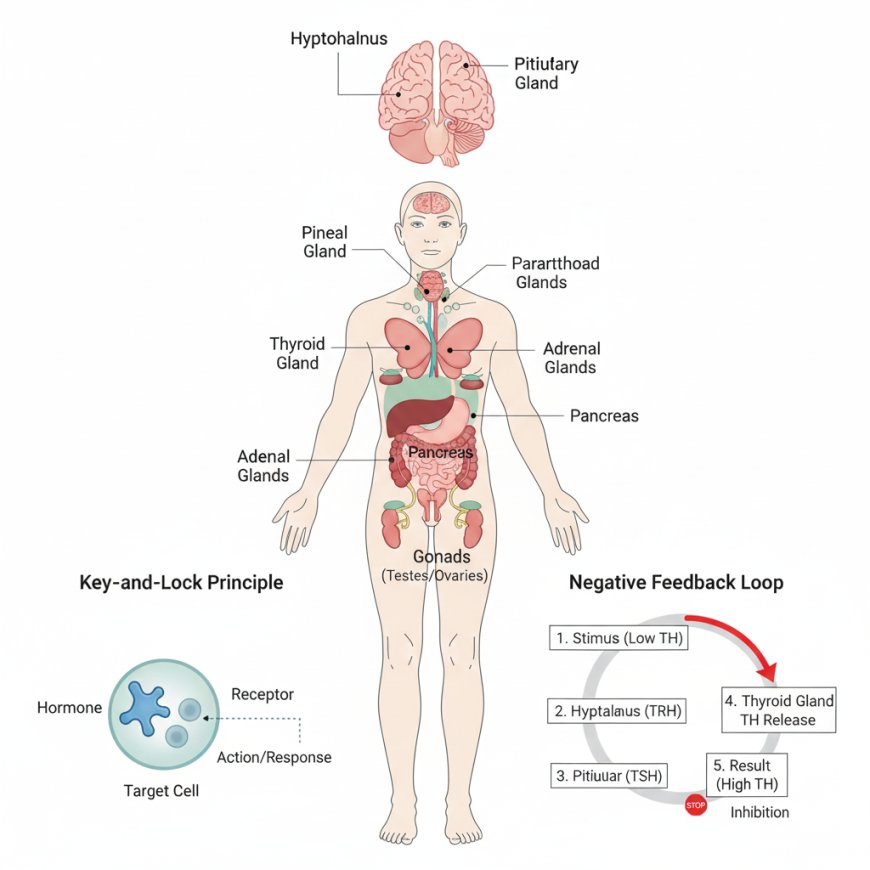
The Key-and-Lock Principle (Target Cells): Although hormones reach everywhere, they only affect specific cells, called target cells. A hormone acts like a key, and the target cell has a specific receptor (a lock) that fits that key. When the hormone binds to the receptor, it tells the cell to perform a specific action, such as growing, starting metabolism, or releasing another substance.
2. Primary Functions of the Endocrine System
The endocrine system influences almost every cell, organ, and function in your body. Its main responsibilities include:
-
Homeostasis: Maintaining a constant internal balance (like regulating blood sugar, water, and salt).
-
Metabolism: Controlling how your body gets energy from the food you eat.
-
Growth and Development: Managing growth from childhood into adulthood.
-
Sexual Function and Reproduction: Controlling puberty, menstrual cycles, and sperm production.
-
Mood and Stress Response: Managing your body's reaction to stress (the "fight-or-flight" response) and influencing mood.
🏛️ The Central Command Center: Hypothalamus and Pituitary
These two structures, located in the brain, are the supreme regulators of the entire system.
1. The Hypothalamus: The Link
-
Location: Deep within the brain.
-
Function: It is the primary link between the nervous system and the endocrine system. It receives information from the brain about the outside world (stress, light, temperature) and translates it into instructions for the pituitary gland.
-
Method: It produces releasing and inhibiting hormones that tell the pituitary gland what to do. It also produces two hormones (Oxytocin and Antidiuretic Hormone, ADH) that are sent to the posterior pituitary for storage and release.
2. The Pituitary Gland: The Master Gland
-
Location: At the base of the brain, about the size of a pea.
-
Function: Often called the "master gland" because the hormones it releases control many other endocrine glands.
-
Anterior Pituitary: Produces and releases hormones that stimulate other glands, such as:
-
TSH (Thyroid-Stimulating Hormone)
-
ACTH (Adrenocorticotropic Hormone)
-
GH (Growth Hormone)
-
-
Posterior Pituitary: Stores and releases the hormones (ADH and Oxytocin) that were produced by the hypothalamus.
⚙️ Major Endocrine Glands and Their Roles
The other major glands are controlled by the pituitary and release their specific hormones to regulate various body processes.
| Gland | Location | Major Hormone(s) | Primary Function |
| Thyroid Gland | Neck, below the voice box | Thyroid Hormone ($T_3$ and $T_4$) | Controls the body's metabolic rate (the speed at which cells use energy). |
| Parathyroid Glands | Four small glands on the back of the thyroid | Parathyroid Hormone (PTH) | The most important regulator of blood calcium levels. |
| Adrenal Glands | On top of each kidney | Cortisol (Stress/Metabolism) & Adrenaline (Epinephrine) | Stress response (fight-or-flight), regulates blood pressure, and manages metabolism. |
| Pancreas | Behind the stomach | Insulin & Glucagon | Regulates blood sugar (glucose) levels. Insulin lowers it; Glucagon raises it. |
| Pineal Gland | Deep in the brain | Melatonin | Regulates the sleep-wake cycle (circadian rhythm). |
| Gonads | Ovaries (female) / Testes (male) | Estrogen & Progesterone / Testosterone | Controls sexual development, reproductive cycles, and secondary sex characteristics. |
🔁 Hormone Regulation: The Feedback Loop
The endocrine system is maintained by a process called a negative feedback loop. This mechanism ensures that hormone levels remain in a narrow, healthy range.
How it Works (Example: Thyroid Hormone)
-
Stimulus: Low levels of Thyroid Hormone ($T_3/T_4$) in the blood.
-
Hypothalamus: Releases TRH (Thyrotropin-Releasing Hormone).
-
Pituitary: TRH stimulates the pituitary to release TSH (Thyroid-Stimulating Hormone).
-
Target Gland: TSH travels to the Thyroid Gland, stimulating it to release $T_3$ and $T_4$.
-
Result: The level of $T_3$ and $T_4$ in the blood rises.
-
Inhibition (Negative Feedback): The now-high level of $T_3$ and $T_4$ signals back to the hypothalamus and pituitary, telling them to stop releasing TRH and TSH. This prevents the hormone level from getting too high.
This constant monitoring and adjustment keep all body systems in harmony.
What's Your Reaction?
 Like
1
Like
1
 Dislike
0
Dislike
0
 Love
0
Love
0
 Funny
0
Funny
0
 Angry
0
Angry
0
 Sad
0
Sad
0
 Wow
0
Wow
0