
















Lecture 3 ptient safety 2nd Medical High and Low Frequency (The Energy of Healing)

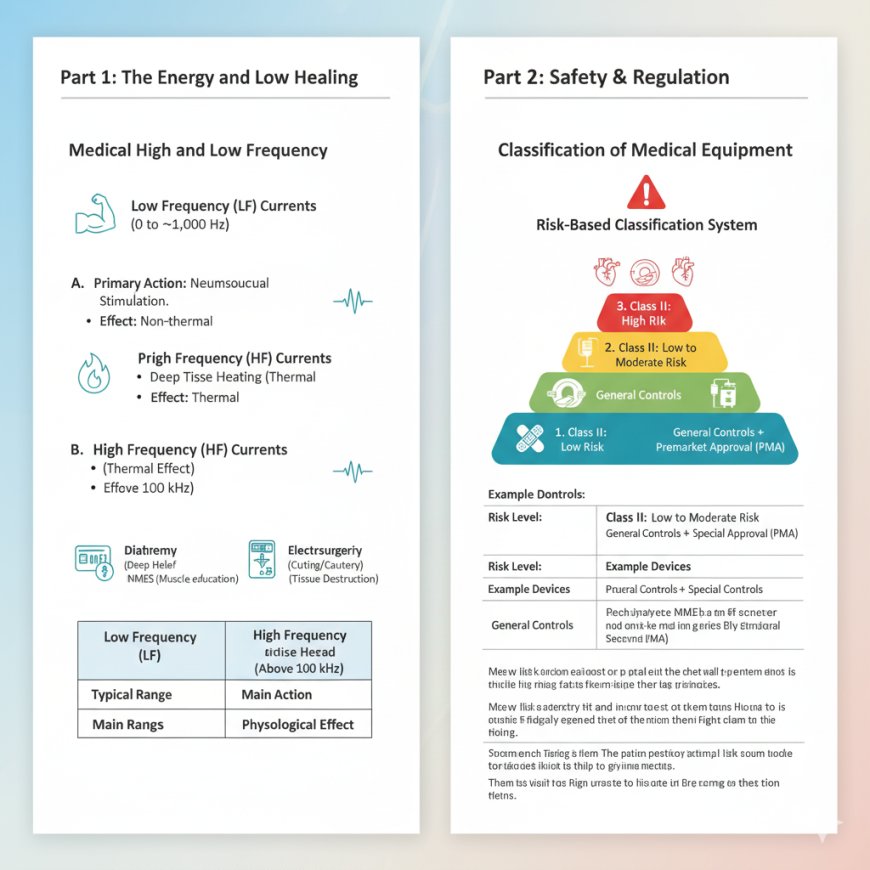
⚡ Part 1: Medical High and Low Frequency (The Energy of Healing)
In medicine and physical therapy, electrical currents and electromagnetic waves are categorized by their frequency (the number of cycles per second, measured in Hertz or Hz). This frequency determines how the energy interacts with human tissue, leading to distinct physiological effects.
A. Low Frequency (LF) Currents (0 to ~1,000 Hz)
-
Primary Action: Neuromuscular Stimulation.
-
LF currents are slow enough to effectively depolarize nerve and muscle membranes, causing nerve stimulation and muscle contraction. They mimic the body's natural electrical signals.
-
-
Effect: Primarily non-thermal (minimal heat generation).
-
Therapeutic Applications:
-
TENS (Transcutaneous Electrical Nerve Stimulation): Used for pain relief (analgesia) by stimulating sensory nerves.
-
NMES (Neuromuscular Electrical Stimulation) / Faradic Current: Used for muscle re-education, strengthening, and reducing atrophy in weak or paralyzed muscles.
-
Electrodiagnosis: Used to test the electrical properties of nerves and muscles.
-
B. High Frequency (HF) Currents (Above 100 kHz, often in MHz/GHz)
-
Primary Action: Deep Tissue Heating (Thermal Effect).
-
HF currents oscillate too rapidly to stimulate motor or sensory nerves effectively. Instead, the rapid oscillation of electrons within the tissue creates resistance, which generates deep, therapeutic heat (Diathermy).
-
-
Effect: Primarily thermal (deep heating), though some applications are non-thermal.
-
Therapeutic Applications:
-
Diathermy (Short-Wave, Microwave): Deep heating of muscles, joints, and tendons to promote blood flow, reduce inflammation, and relieve pain in conditions like arthritis and muscle spasms.
-
Electrosurgery / Electrocautery: Extremely high frequency (up to several MHz) currents are used for cutting and coagulation (cautery) during surgery, providing a bloodless surgical field.
-
Radiofrequency (RF) Ablation: Used to destroy small, unwanted tissues (like tumors or abnormal heart pathways) by generating intense, localized heat.
-
Medical Imaging: Ultrasound uses very high-frequency sound waves (in the MHz range) for detailed imaging.
-
| Feature | Low Frequency (LF) | High Frequency (HF) |
| Typical Range | 0 – 1,000 Hz | > 100 kHz (up to MHz/GHz) |
| Main Action | Nerve & Muscle Stimulation | Deep Tissue Heating |
| Physiological Effect | Contraction, Analgesia | Coagulation, Vasodilation (Diathermy) |
| Examples | TENS, Faradic Current | Electrosurgery, Diathermy, RF Ablation |
🧑⚕️ Part 2: Classification of Medical Equipment
The classification of medical equipment is a regulatory framework used globally (by bodies like the FDA in the US and the European Union's MDR) to ensure patient safety and efficacy. Devices are classified based on the risk they pose to the patient and the manufacturer's intended use.
Risk-Based Classification System
Medical devices are typically grouped into three or four classes, with regulatory control increasing dramatically with risk.
1. Class I: Low Risk (General Controls)
-
Risk Level: Lowest risk to the patient.
-
Controls: Subject only to General Controls, which cover basic requirements like proper labeling, manufacturing processes, and registration.
-
Examples:
-
Tongue depressors
-
Standard adhesive bandages
-
Examination lights
-
2. Class II: Low to Moderate Risk (General + Special Controls)
-
Risk Level: Intermediate risk. Failure or misuse could potentially cause injury.
-
Controls: Requires General Controls plus Special Controls (e.g., mandatory performance standards, post-market surveillance, and sometimes premarket notification (510(k)) to the FDA).
-
Examples:
-
Infusion pumps
-
Surgical drapes
-
CT scanners
-
TENS devices
-
3. Class III: High Risk (Premarket Approval)
-
Risk Level: Highest risk. Devices are often life-sustaining, life-supporting, or implanted, where failure could result in serious injury or death.
-
Controls: Requires General Controls plus Premarket Approval (PMA), which is the most rigorous review process requiring extensive scientific evidence of safety and effectiveness.
-
Examples:
-
Pacemakers
-
Heart valves
-
Implantable defibrillators
-
Breast implants
-
| Class | Risk Level | Example Devices | Regulatory Control |
| I | Low | Tongue Depressors, Bandages | General Controls |
| II | Low to Moderate | CT Scanners, Infusion Pumps | General Controls + Special Controls |
| III | High | Pacemakers, Heart Valves, Implants | General Controls + Premarket Approval (PMA) |
What's Your Reaction?
 Like
0
Like
0
 Dislike
0
Dislike
0
 Love
0
Love
0
 Funny
0
Funny
0
 Angry
0
Angry
0
 Sad
0
Sad
0
 Wow
0
Wow
0