
















Anatomy and Physiology of the Human Nose

Anatomy and Physiology of the Human Nose
INTRODUCTION
The human nose is an important organ of the respiratory system and the sensory system. It helps us breathe, filter air, smell different odors, and also plays a role in voice production. The nose is the first entry point for air that enters the body.
ANATOMY OF THE NOSE
The anatomy of the nose can be divided into external nose and internal nose.
EXTERNAL NOSE
The external nose is the visible part of the nose on the face.
It has the following main parts
Nasal bridge
This is the upper part of the nose formed mostly by nasal bones.
Nasal tip
This is the lower soft part of the nose.
Nostrils or nares
These are two openings that allow air to enter and exit.
Alae
These are the curved outer sides of the nostrils.
Septum
It divides the nose into right and left nostrils.
Internal nose is also called nasal cavity.
INTERNAL NOSE OR NASAL CAVITY
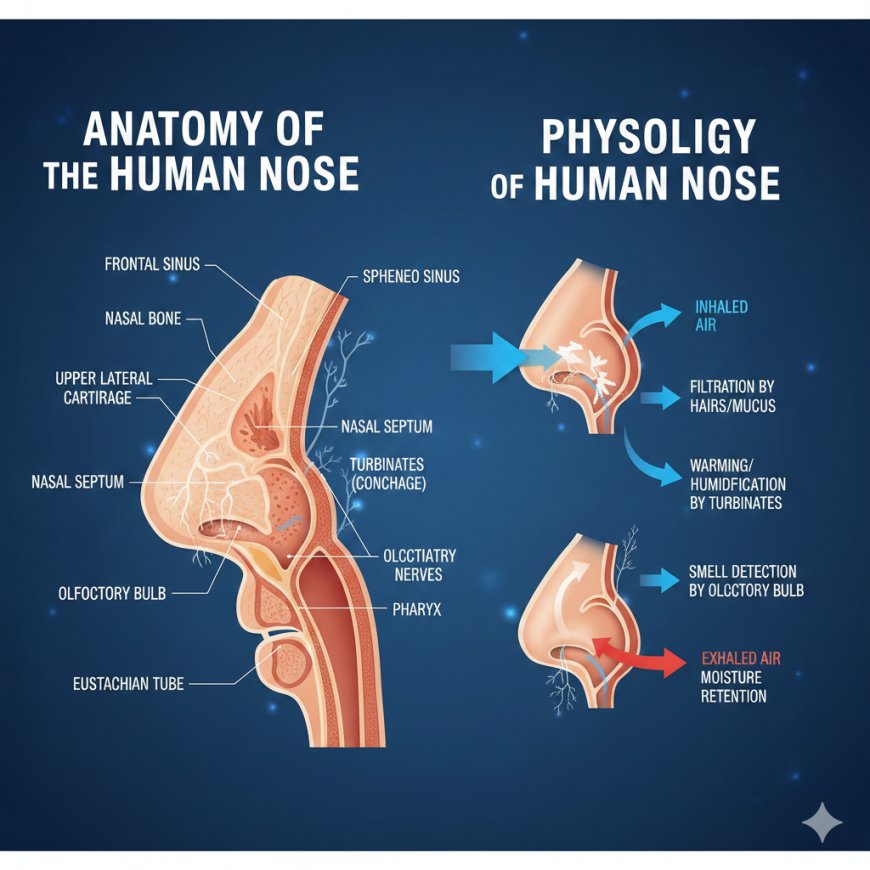
The nasal cavity is a large air filled space inside the nose. It is divided into right and left sides by the nasal septum. The internal nose has the following structures
Nasal septum
Made of cartilage and bone. It divides the nasal cavity into two passages.
Nasal conchae or turbinates
There are three turbinates on each side superior, middle, and inferior.
They increase the surface area inside the nose and warm and humidify air.
Nasal meatuses
Spaces below each turbinate. Air passes through these spaces.
Olfactory region
Located high inside the nasal cavity. Contains smell receptors.
Respiratory region
Covers most of the nasal cavity. Warms, filters, and moistens air.
Paranasal sinuses
Air filled spaces inside bones around the nose.
These include maxillary sinus, frontal sinus, ethmoid sinus, and sphenoid sinus.
Sinuses open into the nasal cavity.
Blood supply
The nose receives rich blood supply from branches of the internal and external carotid arteries.
Kiesselbach’s plexus is a common site of bleeding.
Nerve supply
The trigeminal nerve supplies sensation to the nose.
The olfactory nerve gives the sense of smell.
Autonomic nerves control secretions and blood flow.
PHYSIOLOGY OF THE NOSE
The nose performs many important functions
Breathing
The nose is the main pathway for air to enter the body.
It conducts air to the lungs.
Filtration
The nose filters dust, bacteria, and foreign particles using tiny hairs called cilia and mucus.
Humidification
The nose adds moisture to the air. This prevents dryness of the respiratory tract.
Warming
The nasal blood vessels warm the incoming air to body temperature.
Smell
The olfactory region contains odor receptors.
These receptors detect different smells and send signals to the brain.
Voice resonance
The nose and sinuses act as resonating chambers.
They help in making the voice clear and full.
Protection
Sneezing removes irritants from the nose.
Mucus traps harmful particles.
COMMON CONDITIONS OF THE NOSE
Rhinitis inflammation of nasal mucosa
Sinusitis infection of sinuses
Nasal polyps growths inside the nose
Deviated septum misalignment of nasal septum
Epistaxis nosebleed
What's Your Reaction?
 Like
0
Like
0
 Dislike
0
Dislike
0
 Love
0
Love
0
 Funny
0
Funny
0
 Angry
0
Angry
0
 Sad
0
Sad
0
 Wow
0
Wow
0