















ANATOMY AND PHYSIOLOGY OF THE HUMAN TONGUE

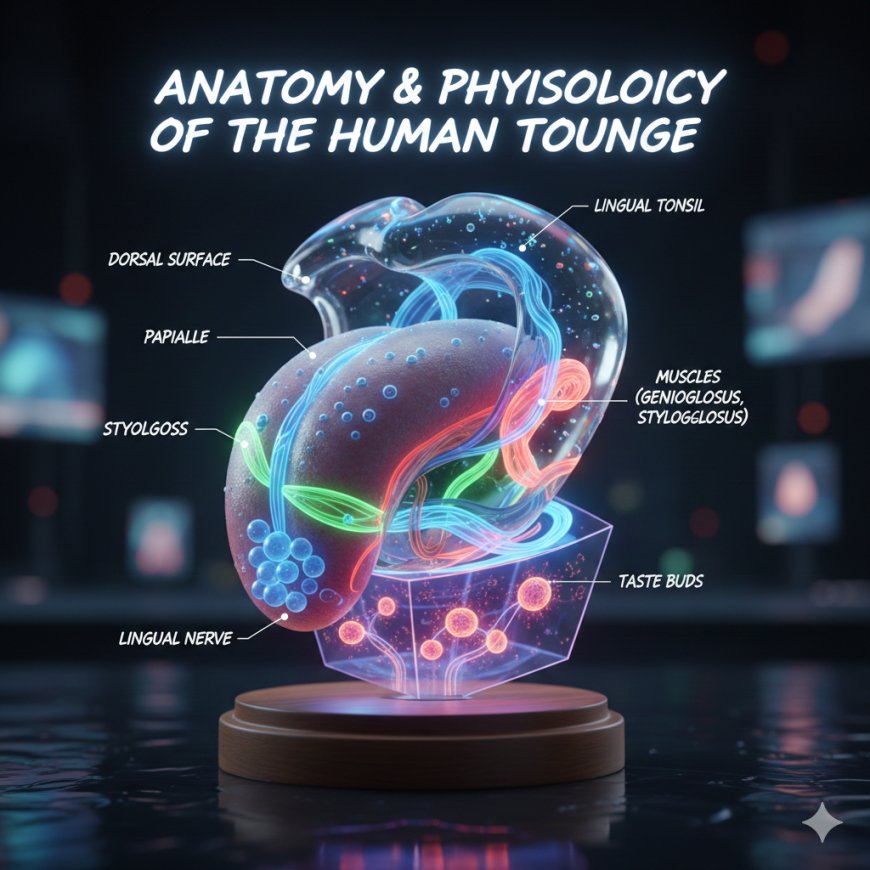
ANATOMY AND PHYSIOLOGY OF THE HUMAN TONGUE
DETAILED LECTURE NOTES
INTRODUCTION
The tongue is a muscular organ located in the oral cavity. It plays an important role in taste, speech, swallowing, chewing, and cleaning the mouth. It is covered with a mucous membrane and contains taste buds that help us detect different tastes.
ANATOMY OF THE TONGUE
1. LOCATION
The tongue lies on the floor of the mouth inside the oral cavity. It is attached to the mandible, the hyoid bone, and the pharynx.
2. PARTS OF THE TONGUE
The tongue has three main parts
3. Tip or apex
4. Body
5. Root or base
6. SURFACES OF THE TONGUE
7. Dorsal surface
The upper surface of the tongue. It contains papillae and taste buds.
8. Ventral surface
The lower surface of the tongue. It is smooth and contains blood vessels.
9. PAPILLAE OF THE TONGUE
Papillae are small projections on the dorsal surface. They increase surface area and contain taste buds.
There are four main types of papillae
1. Filiform papillae
Most numerous.
Thin, hair-like.
Do not contain taste buds.
Help in gripping food.
2. Fungiform papillae
Mushroom-shaped.
Found on the tip and sides of the tongue.
Contain taste buds.
3. Circumvallate papillae
Large, circular papillae arranged in a V-shape at the back of the tongue.
Each contains many taste buds.
4. Foliate papillae
Leaf-like papillae on the lateral sides of the tongue.
Contain taste buds, especially in children.
5. MUSCLES OF THE TONGUE
The tongue contains two types of muscles.
A. Intrinsic muscles
Located inside the tongue.
Help change the shape of the tongue.
Include
1. Superior longitudinal
2. Inferior longitudinal
3. Transverse
4. Vertical
B. Extrinsic muscles
Attach the tongue to surrounding structures.
Help in movement of the tongue.
Include
1. Genioglossus
2. Hyoglossus
3. Styloglossus
4. Palatoglossus
5. BLOOD SUPPLY
The main artery is the lingual artery, a branch of the external carotid artery.
Venous drainage occurs through the lingual veins.
6. NERVE SUPPLY
The tongue has sensory and motor nerves.
Motor nerve
Hypoglossal nerve (cranial nerve XII) supplies all tongue muscles except palatoglossus which is supplied by the vagus nerve.
Sensory nerves
Anterior two-thirds
General sensation by lingual nerve
Taste sensation by chorda tympani nerve
Posterior one-third
General and taste sensation by glossopharyngeal nerve
Very back of tongue
Supplied by vagus nerve
---
PHYSIOLOGY OF THE TONGUE
1. TASTE SENSATION
Taste buds detect taste. Each taste bud contains receptor cells that respond to chemicals in food.
The five basic tastes are
1. Sweet
2. Sour
3. Salty
4. Bitter
5. Umami or savoury
Taste pathway
Taste receptors → cranial nerves (VII, IX, X) → brainstem → thalamus → gustatory cortex
2. SPEECH
The tongue helps in articulation of words and production of sounds. Specific movements of the tip, sides, and back of the tongue produce different sounds.
3. SWALLOWING
The tongue pushes food toward the pharynx during swallowing. It forms the food into a bolus and initiates swallowing.
4. CHEWING
The tongue helps in mixing food with saliva and positioning food between the teeth.
5. CLEANING AND PROTECTION
The tongue helps clean the oral cavity and contains mucus that keeps the mouth moist.
---
CLINICAL NOTE
Glossitis
Inflammation of the tongue.
Causes include vitamin deficiency, infection, or allergic reaction.
Tongue tie
Short lingual frenulum that restricts movement of the tongue.
Taste disorders
Loss of taste due to nerve damage, infections, or medication.
---
SHORT QUESTIONS
1. Name the four types of papillae on the tongue.
2. What is the main motor nerve of the tongue
3. Define taste bud.
4. What are intrinsic muscles of the tongue
5. Name the five basic tastes.
LONG QUESTIONS
1. Describe the anatomy of the tongue in detail.
2. Explain the physiology of taste sensation.
3. Write in detail about the muscles and nerve supply of the tongue.
What's Your Reaction?
 Like
0
Like
0
 Dislike
0
Dislike
0
 Love
0
Love
0
 Funny
0
Funny
0
 Angry
0
Angry
0
 Sad
0
Sad
0
 Wow
0
Wow
0