










Lecture on mitosis and meiosis

Both Mitosis and Meiosis are essential types of cell division that allow living organisms to grow, repair, and reproduce. They start with a single parent cell and end with new daughter cells, but they have different goals and outcomes.
🔬 Mitosis: Cell Replication for Growth and Repair
Mitosis is the process that creates two genetically identical cells from one parent cell. Think of it as making a perfect clone.
Basic Description
-
Purpose: Primarily for growth (increasing the number of cells in an organism) and repair/replacement (replacing old, dead, or damaged cells). It is also the basis of asexual reproduction in some organisms.
-
Starting Cell: A single diploid ($2n$) parent cell (a cell with two sets of chromosomes, one from each parent). This occurs in most non-reproductive body cells, called somatic cells (like skin, muscle, or liver cells).
-
Resulting Cells: Two genetically identical daughter cells, which are also diploid ($2n$). The chromosome number remains the same as the parent cell.
-
Divisions: One single round of division.
Importance (SLO-based)
| Objective | Importance of Mitosis |
| Growth & Development | Produces the vast number of cells needed for an organism to grow from a fertilized egg (zygote) into an adult. |
| Tissue Repair | Replaces cells damaged by injury or disease, ensuring wounds heal and organs maintain function. |
| Maintenance & Replacement | Continuously replaces short-lived cells (like skin or blood cells) to keep tissues healthy. |
| Genetic Stability | Ensures every new somatic cell has an exact, complete, and identical copy of the organism's DNA. |
🧬 Meiosis: Cell Replication for Sexual Reproduction
Meiosis is a specialized process that creates four genetically unique cells, each with half the chromosome number of the parent cell.
Basic Description
-
Purpose: Essential for sexual reproduction. Its goal is to produce gametes (sex cells: sperm in males, eggs in females).
-
Starting Cell: A single diploid ($2n$) parent cell, but only occurring in germ cells (cells in the reproductive organs).
-
Resulting Cells: Four genetically unique daughter cells, which are haploid ($n$) (a cell with only one set of chromosomes). The chromosome number is halved.
-
Divisions: Two consecutive rounds of division (Meiosis I and Meiosis II).
-
Key Feature: During Meiosis I, a process called crossing over occurs, where homologous chromosomes exchange segments of DNA, leading to new combinations of genes. This is the source of genetic uniqueness.
| Objective | Importance of Meiosis |
| Halving the Chromosome Number | Reduces the chromosome number from diploid ($2n$) to haploid ($n$) so that when two gametes (sperm and egg) fuse during fertilization, the resulting offspring (zygote) restores the correct, constant diploid number for the species. |
| Genetic Diversity | Introduces genetic variation through crossing over and the independent assortment of chromosomes. This diversity is crucial for a species' long-term survival and adaptation to changing environments. |
| Formation of Gametes | It is the fundamental process that creates the specialized sex cells (sperm and egg) required for sexual reproduction. |
📊 Summary of Differences
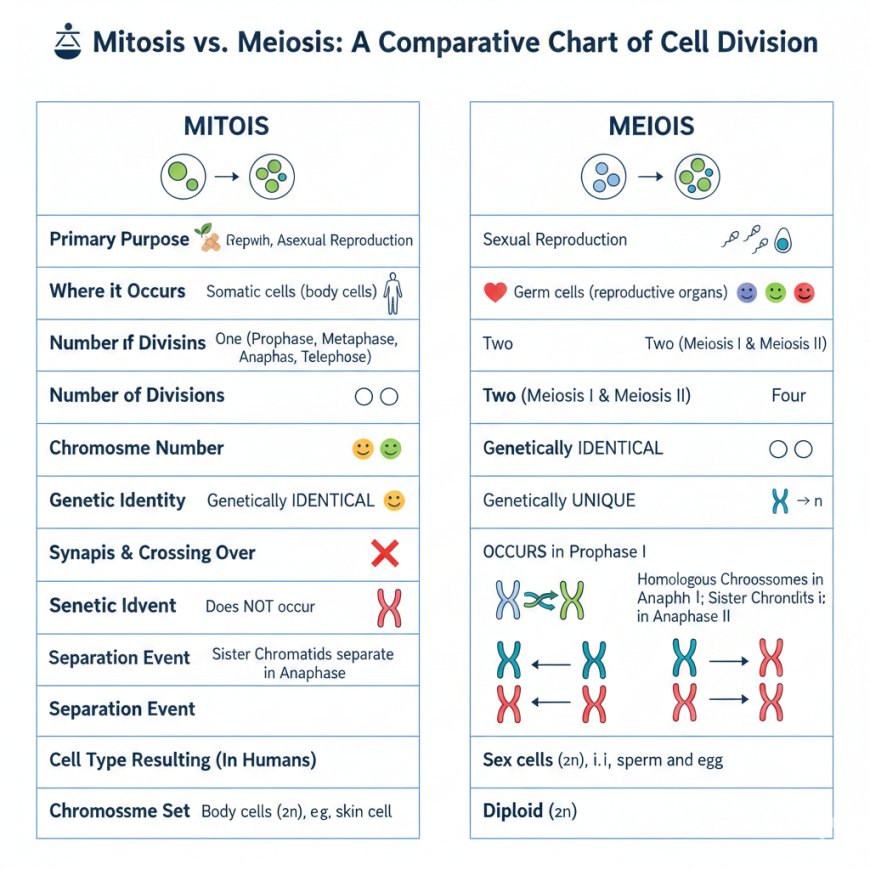
| Feature | Mitosis | Meiosis |
| Type of Cell | Somatic (Body) Cells | Germ (Reproductive) Cells |
| Number of Divisions | One | Two (Meiosis I & II) |
| Daughter Cells Produced | Two | Four |
| Chromosome Number | Maintained (Diploid $2n \rightarrow 2n$) | Halved (Diploid $2n \rightarrow n$) |
| Genetic Identity | Genetically Identical to parent and each other | Genetically Unique from parent and each other |
| Key Role | Growth, Repair, Tissue Maintenance, Asexual Reproduction | Sexual Reproduction, Genetic Diversity |
What's Your Reaction?
 Like
0
Like
0
 Dislike
0
Dislike
0
 Love
0
Love
0
 Funny
0
Funny
0
 Angry
0
Angry
0
 Sad
0
Sad
0
 Wow
0
Wow
0