















Common Reproductive Hormones: Male vs. Female

Common Reproductive Hormones: Male vs. Female
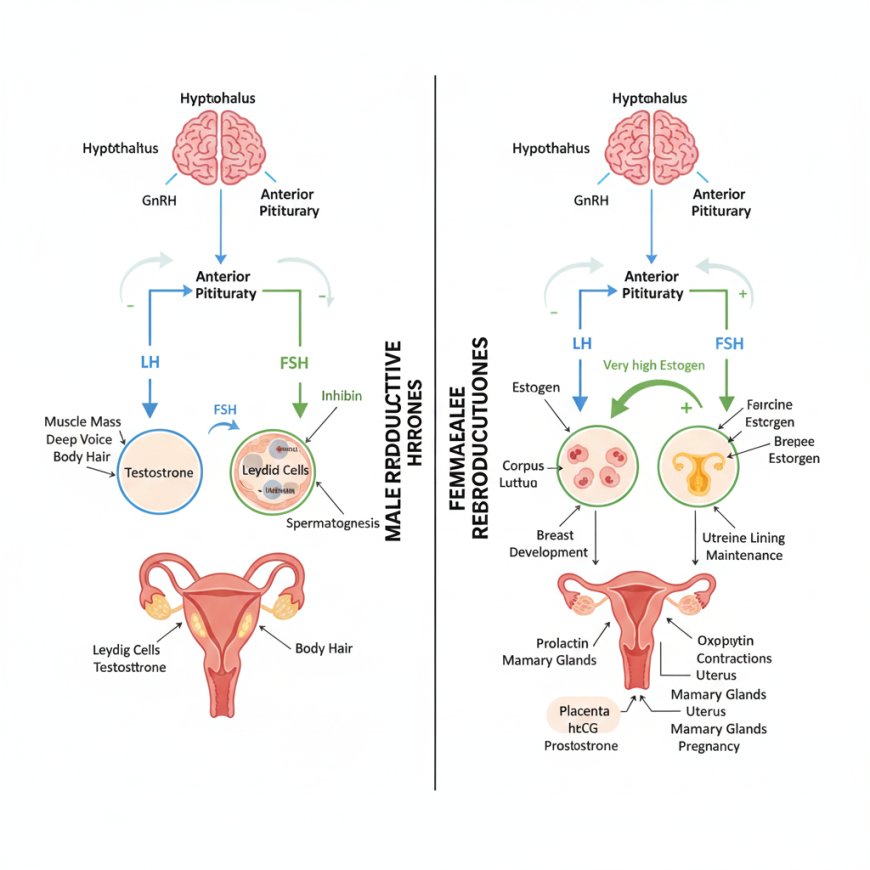
This chart outlines the major hormones, their primary sources, and their key functions in both sexes.
| Hormone | Primary Source(s) | Key Functions in Males | Key Functions in Females |
| Gonadotropin-Releasing Hormone (GnRH) | Hypothalamus | Stimulates anterior pituitary to release FSH and LH. | Stimulates anterior pituitary to release FSH and LH; critical for menstrual cycle initiation and ovulation. |
| Follicle-Stimulating Hormone (FSH) | Anterior Pituitary |
- Stimulates Sertoli cells to support spermatogenesis.
- Stimulates Sertoli cells to produce Androgen-Binding Protein (ABP). |
- Stimulates follicular growth and development in the ovary.
- Stimulates granulosa cells to produce estrogen. |
| Luteinizing Hormone (LH) | Anterior Pituitary | - Stimulates Leydig cells to produce testosterone. |
- Triggers ovulation.
- Stimulates corpus luteum formation and maintenance (secreting progesterone and estrogen). |
| Testosterone (an Androgen) |
- Leydig cells in testes
- Adrenal cortex (minor) |
- Primary male sex hormone.
- Essential for spermatogenesis.
- Development and maintenance of male secondary sexual characteristics (muscle mass, deep voice, hair growth).
- Sex drive. |
- Precursor for estrogen synthesis.
- Contributes to female libido.
- Involved in bone and muscle mass. |
| Estrogen (e.g., Estradiol) |
- Granulosa cells in ovarian follicles
- Corpus luteum
- Adrenal cortex (minor)
- Fat cells (from androgens) |
- Involved in bone density and cardiovascular health (in very low levels). |
- Primary female sex hormone.
- Promotes development of female secondary sexual characteristics.
- Stimulates endometrial proliferation during the menstrual cycle.
- Bone health, cardiovascular health. |
| Progesterone |
- Corpus luteum (primarily)
- Adrenal cortex (minor)
- Placenta (during pregnancy) |
- Precursor to other steroid hormones (androgens and estrogens). |
- Prepares and maintains the endometrium for implantation.
- Maintains pregnancy.
- Inhibits uterine contractions.
- Raises basal body temperature. |
| Inhibin |
- Sertoli cells in testes
- Granulosa cells in ovarian follicles
- Corpus luteum |
- Selectively inhibits FSH release from the anterior pituitary. | - Selectively inhibits FSH release from the anterior pituitary. |
| Prolactin | Anterior Pituitary | - Minor role, possibly involved in male reproductive function, but less understood. | - Stimulates milk production (lactation) after childbirth. |
| Oxytocin | Posterior Pituitary (produced in hypothalamus) | - May play a role in sperm transport within the male reproductive tract. |
- Stimulates uterine contractions during labor.
- Triggers milk ejection (let-down reflex) during breastfeeding.
- Involved in bonding and social behaviors. |
| Human Chorionic Gonadotropin (hCG) | Placenta (after implantation) | Not applicable in males |
- Maintains the corpus luteum during early pregnancy, ensuring continued progesterone production.
- Basis of pregnancy tests. |
Key Differences and Distinctions:
While both sexes share common regulatory hormones like GnRH, FSH, and LH, their specific targets and the primary sex hormones they regulate differ significantly.
-
Primary Sex Hormones:
-
Males: Predominantly Testosterone.
-
Females: Predominantly Estrogen and Progesterone.
-
-
Cyclical vs. Continuous Release:
-
Males: Hormone levels (especially testosterone) are relatively continuous after puberty, maintaining steady spermatogenesis.
-
Females: Hormone levels (estrogen, progesterone, FSH, LH) are highly cyclical, driving the ovarian and uterine cycles.
-
-
Feedback Mechanisms:
-
Both use negative feedback, but females also exhibit positive feedback (e.g., high estrogen leading to LH surge) to trigger ovulation.
-
-
Pregnancy-Specific Hormones:
-
hCG is unique to pregnancy in females, playing a crucial role in maintaining the early pregnancy.
-
The placenta becomes a major endocrine organ during pregnancy, producing high levels of estrogen and progesterone.
-
-
Glandular Secretions:
-
Males have prostate and seminal vesicle secretions as part of semen production.
-
Females have vestibular glands for lubrication, and mammary glands for lactation (regulated by hormones like prolactin and oxytocin).
-
These differences highlight the distinct biological roles of the male and female reproductive systems, yet both are intricately linked through the fundamental HPG axis.
What's Your Reaction?
 Like
0
Like
0
 Dislike
0
Dislike
0
 Love
0
Love
0
 Funny
0
Funny
0
 Angry
0
Angry
0
 Sad
0
Sad
0
 Wow
0
Wow
0