

















Lecture physiology Tissues and Body Fluids

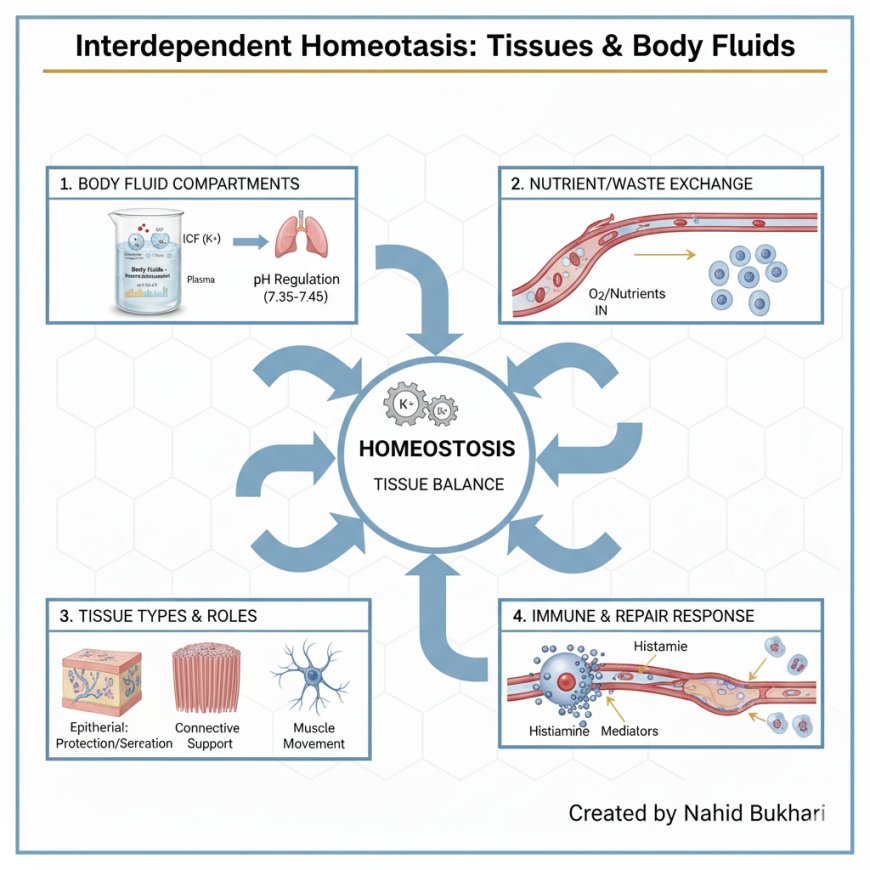
Tissues and Body Fluids
– Basic Physiology
The human body is made up of millions of cells that work together in an organized way. These cells group to form tissues, organs, and body systems. Physiology is the study of how these cells and tissues function to keep the body alive and healthy. A “humanized” view means understanding how all these parts interact and depend on each other, rather than studying them separately.
Body Fluids and Their Importance
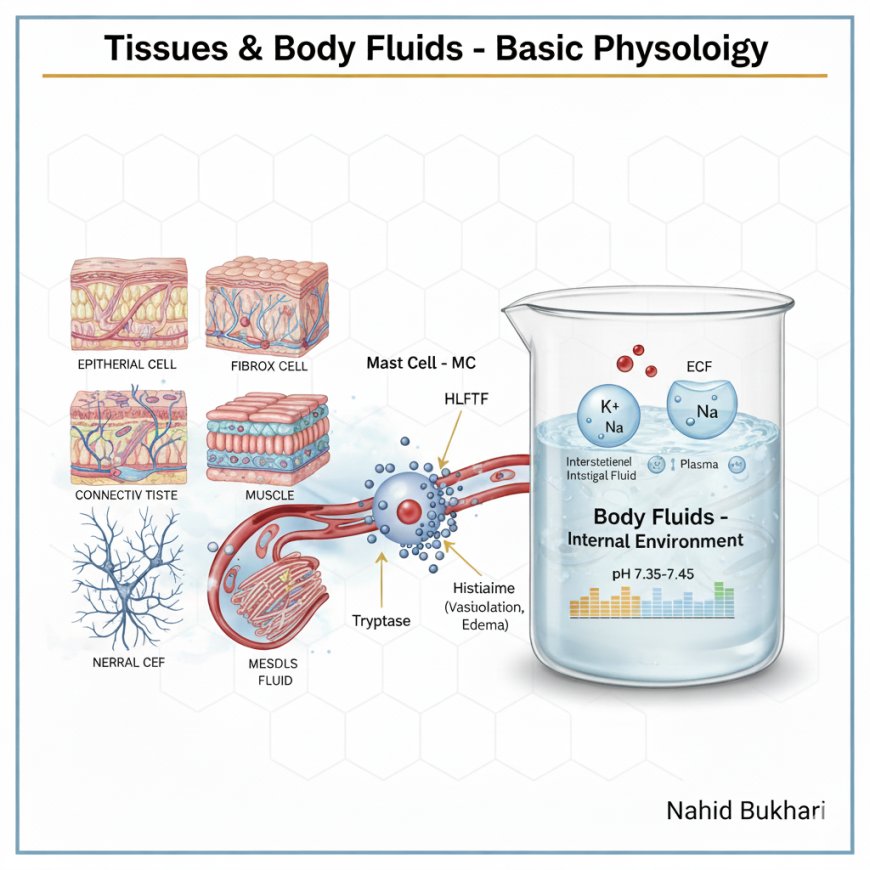
About 60% of the human body is water, which is divided into two main parts: the intracellular fluid (inside the cells) and the extracellular fluid (outside the cells). The intracellular fluid makes up about two-thirds of the total body water and contains mainly potassium and phosphate ions. The extracellular fluid makes up one-third and is rich in sodium and chloride ions. The extracellular fluid is further divided into interstitial fluid (around the cells), plasma (the liquid part of blood), and a small amount of transcellular fluid (such as cerebrospinal or joint fluid).
Body fluids are very important because they act as a medium for all chemical reactions, help in the transport of nutrients, gases, and waste products, and maintain the balance of temperature and pressure inside the body. The composition of these fluids must remain constant for cells to function properly. The body maintains this balance through a process called homeostasis, controlled by hormones such as ADH (which helps the kidneys retain water) and aldosterone (which conserves sodium).
The Four Basic Types of Human Tissues
The human body has four main types of tissues: epithelial, connective, muscular, and nervous tissue.
Epithelial tissue covers the body surface and lines organs, cavities, and glands. It protects, absorbs, and secretes substances. For example, the skin protects against injury, and the lining of the intestine absorbs nutrients. There are several types of epithelial tissue, such as simple squamous (flat cells for diffusion), cuboidal (cube-shaped for secretion), and columnar (tall cells for absorption).
Connective tissue supports and connects other tissues. It includes bone, cartilage, fat (adipose tissue), and blood. Its cells are spread out in a matrix made of fibers and ground substance. Loose connective tissue provides cushioning and elasticity, dense connective tissue forms tendons and ligaments, cartilage gives flexible support, bone provides strength, and blood serves as a transport medium.
Muscle tissue is specialized for movement. There are three kinds: skeletal muscle, which moves body parts and is under voluntary control; cardiac muscle, which makes up the heart and works automatically; and smooth muscle, which is found in the walls of internal organs like the stomach and blood vessels. Muscle contraction happens through interactions of actin and myosin filaments.
Nervous tissue is responsible for communication and coordination. It consists of neurons, which transmit impulses, and supporting cells called neuroglia. Neurons receive signals through dendrites and send them through axons. Nerve impulses are electrical and chemical in nature and allow the body to respond quickly to changes in the environment.
Relationship Between Tissues and Body Fluids
Tissues and body fluids constantly interact. Nutrients and oxygen are carried by the blood (a connective tissue) to epithelial, muscle, and nerve cells. These cells release waste products into the extracellular fluid, which are then removed by the blood and excreted from the body. If fluid balance is disturbed — for example, during dehydration or edema — tissue function can be affected. For instance, lack of water can cause cells to shrink, while excess fluid can cause swelling.
Homeostasis – The Body’s Balancing System
Homeostasis means maintaining a stable internal environment. The body uses feedback mechanisms to do this. In a negative feedback system, any change is corrected by a response that brings the body back to normal (for example, when body temperature rises, sweating helps cool it down). In positive feedback, the change is reinforced until a specific event occurs, such as during childbirth when oxytocin increases uterine contractions.
Clinical Importance
When the balance of fluids or electrolytes is disturbed, diseases can occur. Dehydration causes the extracellular fluid to decrease, leading to weakness and low blood pressure. Edema happens when fluid collects in the tissues, causing swelling. Hyponatremia (low sodium) can cause confusion or seizures, while hyperkalemia (high potassium) can lead to dangerous heart rhythms. These examples show how closely tissue function depends on proper fluid balance.
Summary
In summary, cells form tissues, tissues form organs, and organs work together in systems to keep the body functioning. Body fluids provide the environment in which all cellular activities occur. The structure and function of tissues, along with the composition and control of body fluids, form the basic foundation of human physiology. When these are well balanced, the body stays healthy and performs efficiently.
What's Your Reaction?
 Like
0
Like
0
 Dislike
0
Dislike
0
 Love
0
Love
0
 Funny
0
Funny
0
 Angry
0
Angry
0
 Sad
0
Sad
0
 Wow
0
Wow
0