


















Lecture on the Lymphatic System Anatomy and Physiology

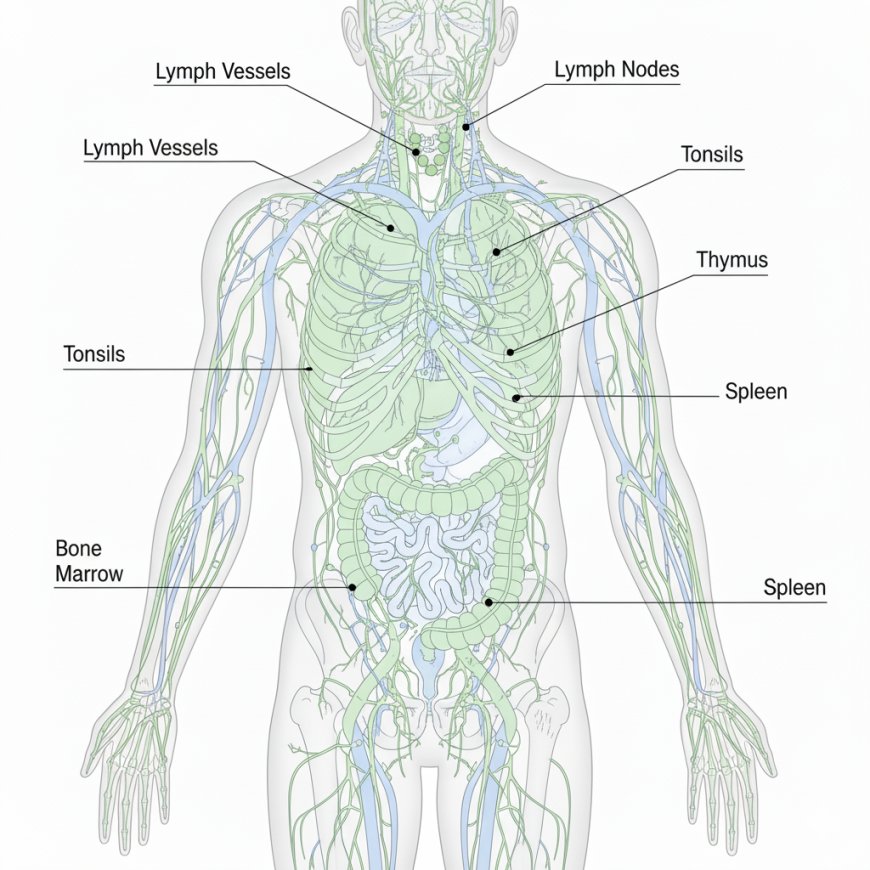
The Lymphatic System
1. Introduction
The lymphatic system is a vital part of both the circulatory system and the immune system. It is a network of lymphatic vessels, lymph nodes, and lymphoid organs that helps maintain fluid balance in the body, absorb fats from the digestive system, and defend against infections. While the cardiovascular system circulates blood, the lymphatic system collects the excess fluid that leaks out of capillaries into tissues, filters it, and returns it to the bloodstream. This fluid is called lymph.
In simple terms, the lymphatic system acts as a drainage and defense system — it prevents fluid buildup (edema), helps the body absorb dietary fats, and protects against disease-causing microorganisms.
2. Basic Structure of the Lymphatic System
The lymphatic system consists of:
-
Lymphatic capillaries
-
Larger lymphatic vessels and ducts
-
Lymph nodes
-
Lymphoid organs – such as the spleen, thymus, tonsils, Peyer’s patches, and bone marrow.
2.1 Lymph
Lymph is a clear, watery fluid formed when interstitial fluid (the fluid that surrounds tissue cells) enters the lymphatic capillaries. It contains water, electrolytes, small amounts of protein, lymphocytes (a type of white blood cell), and sometimes absorbed fats called chyle (especially from the intestines).
2.2 Lymphatic Capillaries
These are tiny, blind-ended tubes found in most tissues of the body, especially just beneath the skin and around blood capillaries. Their thin, one-cell-thick walls make them very permeable, allowing large molecules and excess fluid to enter easily.
They are absent in some areas like the brain, spinal cord, and bone marrow.
2.3 Lymphatic Vessels
Lymphatic capillaries join to form larger vessels, which have valves similar to veins to ensure that lymph flows in one direction — toward the heart. These vessels transport lymph through lymph nodes, which act as filters.
2.4 Lymph Nodes
Lymph nodes are small, bean-shaped structures located along the lymphatic vessels. Each node has an outer cortex (with B cells and T cells) and an inner medulla (with macrophages and plasma cells). They filter lymph, trapping bacteria, viruses, and other foreign substances, which are then destroyed by white blood cells. Clusters of lymph nodes are found in areas like the neck, armpits, groin, chest, and abdomen.
2.5 Lymphatic Ducts
Lymph from all parts of the body eventually drains into two large ducts:
-
Right lymphatic duct – drains lymph from the right upper part of the body into the right subclavian vein.
-
Thoracic duct – drains lymph from the rest of the body into the left subclavian vein.
Thus, the lymphatic system connects back to the venous circulation, completing the fluid transport loop.
3. Lymphoid Organs and Tissues
Apart from lymph nodes and vessels, there are specialized lymphoid organs involved in immune function:
-
Thymus gland – located behind the sternum; site of T-lymphocyte (T-cell) maturation.
-
Spleen – the largest lymphoid organ; filters blood, removes old red blood cells, and produces lymphocytes.
-
Tonsils – located in the throat; provide protection against inhaled or ingested pathogens.
-
Peyer’s patches – clusters of lymphoid tissue in the small intestine; protect the digestive tract.
-
Bone marrow – the site where all blood cells, including lymphocytes, are formed.
Together, these organs form the immune defense network of the body.
4. Physiology of the Lymphatic System
The physiology (functioning) of the lymphatic system can be divided into three main roles:
4.1. Maintenance of Fluid Balance
In capillary beds, part of the plasma from the blood leaks out into the surrounding tissues due to hydrostatic pressure. Most of this fluid returns to the bloodstream by osmosis, but about 10% remains in the interstitial spaces. If not removed, this fluid would cause tissue swelling (edema).
Lymphatic capillaries absorb this remaining fluid and return it to the blood circulation through the lymphatic ducts. This process maintains blood volume and pressure while preventing edema.
4.2. Absorption of Fats
Special lymphatic capillaries in the small intestine called lacteals absorb dietary fats and fat-soluble vitamins (A, D, E, K) from digested food. The absorbed fat appears as a milky fluid called chyle. This chyle is carried through the lymphatic system and eventually enters the bloodstream via the thoracic duct.
This function is vital because large fat molecules cannot be directly absorbed into the bloodstream through normal capillaries.
4.3. Immunological Defense
The lymphatic system is an essential part of the immune system. Lymph nodes, spleen, thymus, and other lymphoid tissues contain lymphocytes (T cells and B cells) and macrophages that defend the body against pathogens.
-
Lymph nodes act as biological filters, removing microbes and foreign materials.
-
T lymphocytes are responsible for cell-mediated immunity — they destroy infected or abnormal cells.
-
B lymphocytes produce antibodies — proteins that neutralize pathogens or mark them for destruction.
-
Macrophages engulf and digest microbes through phagocytosis.
When pathogens are detected, the lymphatic system triggers an immune response, often causing lymph node swelling (as seen in infections).
5. Flow of Lymph (Lymph Circulation)
Lymph flow is unidirectional, from the tissues toward the heart. Unlike blood, lymph is not pumped by the heart but moved by several mechanisms:
-
Skeletal muscle contraction: Muscles compress lymph vessels during movement, pushing lymph forward.
-
Respiratory movements: Breathing changes pressure in the chest, helping lymph flow toward the heart.
-
Valves in lymph vessels: Prevent backflow, ensuring one-way movement.
-
Smooth muscle in vessel walls: Gentle rhythmic contractions propel lymph.
The rate of lymph flow increases during exercise and decreases during rest.
6. Advanced Physiological Concepts
6.1. Lymph Formation (Starling’s Forces)
Lymph formation depends on Starling’s forces, which balance fluid movement across capillary walls:
[
Net\ filtration = (Capillary\ hydrostatic\ pressure - Interstitial\ hydrostatic\ pressure) - (Capillary\ oncotic\ pressure - Interstitial\ oncotic\ pressure)
]
When filtration exceeds reabsorption, excess fluid enters the lymphatic capillaries, forming lymph.
6.2. Lymphatic Pump Mechanism
In some areas, particularly large vessels, lymphatic smooth muscles act as an internal lymph pump, contracting rhythmically to move lymph forward. This ensures continuous drainage even in areas of low muscle activity.
6.3. Lymphatic System and Immunity Integration
Lymphoid organs continuously monitor the lymph for pathogens. The antigen-presenting cells (APCs), such as dendritic cells, present foreign antigens to T cells, initiating adaptive immune responses. Memory lymphocytes ensure faster responses upon re-exposure to the same pathogen.
7. Clinical Correlations
-
Lymphedema: Swelling due to blockage or removal of lymph vessels (e.g., after cancer surgery).
-
Filariasis (Elephantiasis): Parasitic infection (by Wuchereria bancrofti) that blocks lymph drainage, causing massive limb swelling.
-
Lymphadenopathy: Enlargement of lymph nodes due to infection, inflammation, or cancer.
-
Lymphoma: Cancer of lymphatic tissue (e.g., Hodgkin’s and Non-Hodgkin’s lymphoma).
-
Chylothorax: Leakage of chyle into the pleural cavity due to thoracic duct injury.
8. Summary
The lymphatic system is a complex network that keeps the body’s fluid levels balanced, helps absorb fats from the intestine, and provides strong immune defense. It collects excess interstitial fluid, filters it through lymph nodes where immune cells attack pathogens, and returns it to the blood. The flow of lymph is maintained by body movement, pressure changes, and vessel valves. Without this system, our body would swell with fluid, and our immunity would be severely weakened.
In summary:
-
Structural components: Lymph, lymphatic vessels, nodes, and lymphoid organs.
-
Functions: Fluid balance, fat absorption, immune defense.
-
Clinical relevance: Disorders like lymphedema, infections, and lymphomas highlight its importance.
Thus, the lymphatic system works quietly but continuously to protect, cleanse, and maintain the internal environment of the human body.
What's Your Reaction?
 Like
0
Like
0
 Dislike
0
Dislike
0
 Love
0
Love
0
 Funny
0
Funny
0
 Angry
0
Angry
0
 Sad
0
Sad
0
 Wow
0
Wow
0